
Showing posts with label JFK Assassination. Show all posts
Showing posts with label JFK Assassination. Show all posts
Tuesday, September 23, 2014

Thursday, September 18, 2014
JFK Assassination: Richard Belzer: Hit List
Mae
Brussell’s article: The Last Words of Lee Harvey Oswald: http://www.maebrussell.com/Mae%20Brussell%20Articles/Last%20Words%20of%20Lee%20Oswald.html
Wednesday, September 3, 2014
Allen Dulles: Harvard Law School Forum: December 13, 1963
Harvard
Law School Forum

From a tape recording
beginning at about 47:35: “There never has been a political action, or an action
of a political nature – Bay of Pigs, U-2, uh, Vietnam and the security services
– there never has been an operation of that kind that had not been approved from
the very beginning, at its very inception at the “highest” level of government
and approved. Now when there’s a failure, uh, if something blows up – whether
it’s a plane or a Bay of Pigs, you’re going to have criticism. And the CIA then
can’t run out and say, ‘Now look here, we were backed on this by …’ [Audience
laughter] Maybe I should stop? I’m going to very soon. The CIA can’t get up and
say we didn’t have anything to do with this and so forth and so on; just keep
their mouth shut. In both the Bay of Pigs situation and the U-2 situation the
chief executive assumed responsibility – not because I asked him to … not at
all. But because he felt that not to assume responsibility for these particular
actions – and I think he was right – we both were right – would have meant
irresponsibility in government. If I was going to be allowed to sit around there
and say ‘I ought to be allowed to sit around there and send airplanes over
Russia without policy approval, I ought to be shot … or certainly dismissed.’
[Audience laughter] … or mount a Bay of Pigs operation without approval, the
same thing should have happened to me. Well, it just didn’t work that
way.”
Wednesday, August 27, 2014
Richard Nixon and the Assassination of John F. Kennedy
I was going through my
Black Op Radio material that I’ve downloaded and I ran across this interesting
tidbit from Lance deHaven-Smith (#628 2013-05-02),
author of Conspiracy Theory in America
(http://utpress.utexas.edu/index.php/books/dehcon) on Richard Nixon’s statement
made to a professor in Moscow regarding the assassination of President
Kennedy.
When Richard Nixon
visited Moscow after the Kennedy assassination and before he ran for president
in ‘68, a professor in Moscow asked Nixon “what do we tell our people and our
students here about the American government and people after President Kennedy
gets assassinated? You’re a freedom-loving people, and yet this leader is
assassinated and nothing happens, and it’s not investigated
carefully.”
And Nixon says, “Well, I
could ask you what happened to your KGB head [Lavrentiy] Beria, or what happened to Trostsky who was assassinated?”
The upshot of this was
that Nixon was saying, in effect, that Kennedy was like Trotsky. He got on
the “outs” with the ruling powers and they took him out.
Vince Salandria, a Philadelphia attorney, came to the same
conclusion early on.
http://spot.acorn.net/jfkplace/09/fp.back_issues/27th_Issue/vs_text.html
ADDENDUM: In the 1960s,
anyone who ran against Richard Nixon, or was a threat to run against him, got
shot: John Kennedy, Robert Kennedy and George Wallace. Strange, huh?
Thursday, July 10, 2014

Wednesday, May 28, 2014
JFK Assassintion: The Last Two Days
One of the strangest
omissions in the subsequent investigation by federal authorities concerns a Navy
commander who was assigned to film major events involving President Kennedy.
In early 1963, Thomas Atkins was assigned as an
official photographer for the Kennedy White House. As [16] such, he traveled to Texas with Kennedy and was
photographing the motorcade with a quality camera–a 16mm Arriflex S. He was riding six cars behind Kennedy and filming as the motorcade moved
through Dealey Plaza.
In a 1977 article,
Atkins said the car he was in had just turned onto Houston Street and was facing
the Texas School Depository, and … Kennedy’s car had just made the left turn
heading toward the freeway entrance. Although I did not look up at the building,
I could hear everything quite clearly … The shots came from below and
off to the right side from where I was [the location of the Grassy Knoll
(or, the street sewer)] … I never thought the shots came
from above. They did not sound like shots coming from anything higher than
street level.
After returning to
Washington on Air Force Two. Atkins assembled his
film into a movie he entitled The Last
Two Days. That film was described as "terribly damaging to the Warren
Commission finding that Lee Harvey Oswald was the lone assassin." Perhaps this
explains why neither Atkins’s testimony, nor his film
were studied by either of the federal panels investigating the
assassination.
Atkins said in 1977:
"It’s something I’ve always wondered about. Why didn’t they ask me what I knew?
I not only was on the White House staff, I was then, and still am, a
photographer with a pretty keen visual sense."
Obviously, the federal
authorities didn’t want to hear from a man with a "keen visual sense" and strong
credentials who might have told them things they did not want to hear. [17] (Crossfire, Jim Marrs pp. 16-17)
Monday, May 19, 2014
Wednesday, April 23, 2014
Beyond JFK: The Question of Conspiracy
I
uploaded Beyond JFK: The Question of Conspiracy at Archive.org some time ago and thought I’d
share it for those who haven’t seen it yet. Click on the photo.
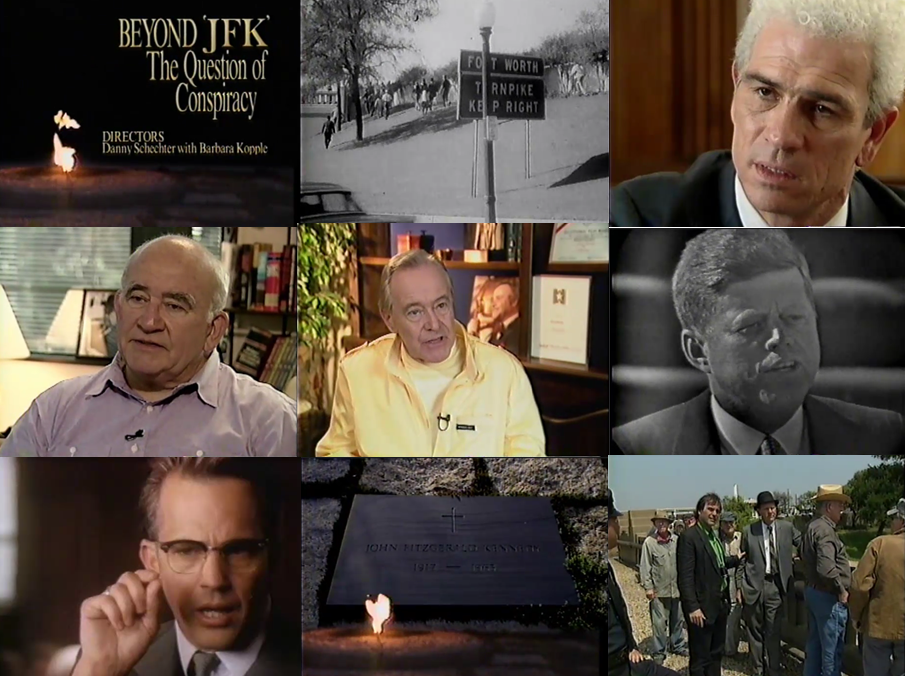
Beyond
JFK: The Question of Conspiracy is a spellbinding documentary examining the
issues dramatized by the Academy Award-winning movie JFK.
Using newsreel and interview footage, this
compelling piece to JFK presents many of the true-life people portrayed in the
film by Kevin Costner, Tommy Lee Jones, John Candy, Kevin Bacon and others and
it does more. Eyewitnesses to the tragic events of November 22, 1963 reveal
astonishing testimony. Supporters of the Warren Commission’s finding provide
counterpoint throughout the program. And details of the world-shattering
investigations by New Orleans District Attorney Jim Garrison are set out with
step-by-step clarity.
Tuesday, April 22, 2014
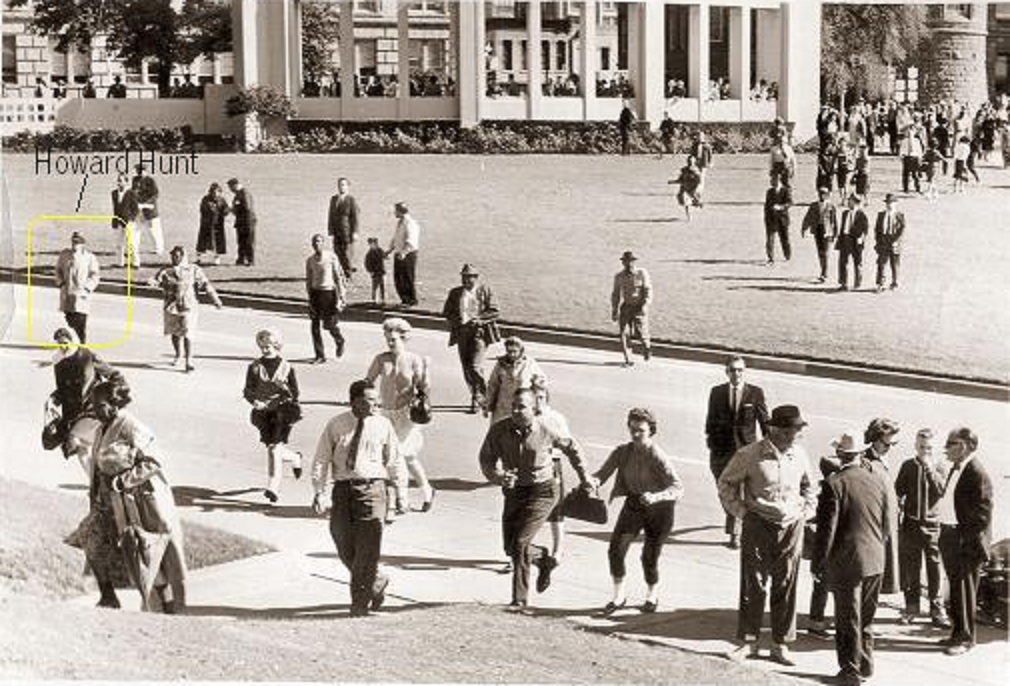
E. Howard Hunt in Dallas November 22, 1963
E. Howard Hunt was in
Dallas the day of the assassination and the photo of him was verified by his
son, Saint. John Hunt. When Jim Marrs showed him the photo, he responded, “That’s
my dad. I recognize that trench coat. He loved it and wore it all the time.” Spooks, Lies and Dopplegangers

Sunday, April 20, 2014
CIA Instructions to Media Assets Regarding Critics of the Warren Commission
This document caused
quite a stir when it was discovered in 1977. Dated 4/1/67, and marked "DESTROY WHEN NO LONGER NEEDED", this
document is a stunning testimony to how concerned the CIA was over
investigations into the Kennedy assassination. Emphasis has been added to
facilitate scanning.
__________
CIA Document #1035-960,
marked "PSYCH" for presumably Psychological Warfare Operations, in the division
"CS", the Clandestine Services, sometimes known as the "dirty tricks"
department.
RE: Concerning Criticism
of the Warren Report
1. Our Concern. From the
day of President Kennedy's assassination on, there has been speculation about
the responsibility for his murder. Although this was stemmed for a time by the
Warren Commission report, (which appeared at the end of September 1964), various
writers have now had time to scan the Commission's published report and
documents for new pretexts for questioning, and there has been a new wave of
books and articles criticizing the Commission's findings. In most cases the
critics have speculated as to the existence of some kind of conspiracy, and
often they have implied that the Commission itself was involved. Presumably as a
result of the increasing challenge to the Warren Commission's report, a public
opinion poll recently indicated that 46% of the American public did not think
that Oswald acted alone, while more than half of those polled thought that the
Commission had left some questions unresolved. Doubtless polls abroad would show
similar, or possibly more adverse
results.
2. This trend of opinion is a
matter of concern to the U.S. government, including our organization. The
members of the Warren Commission were naturally chosen for their integrity,
experience and prominence. They represented both major parties, and they and
their staff were deliberately drawn from all sections of the country. Just
because of the standing of the Commissioners, efforts to impugn their
rectitude and wisdom tend to cast doubt on the whole leadership of American
society. Moreover, there seems to be an increasing tendency to hint that
President Johnson himself, as the one person who might be said to have
benefited, was in some way responsible for the assassination. Innuendo of such
seriousness affects not only the individual concerned, but also the whole
reputation of the American government. Our organization itself is directly
involved: among other facts, we contributed information to the investigation.
Conspiracy theories have frequently thrown suspicion on our organization, for
example by falsely
alleging that Lee Harvey Oswald worked for us. The aim of this dispatch
is to provide material countering and discrediting the claims of the conspiracy
theorists, so as to inhibit the circulation of such claims in other countries.
Background information is supplied in a classified section and in a number of
unclassified attachments.
3. Action. We do not
recommend that discussion of the assassination question be initiated where it is
not already taking place. Where discussion is active [business] addresses are
requested:
a. To discuss the
publicity problem with [?] and friendly elite contacts (especially politicians
and editors), pointing out that the Warren Commission made as thorough an
investigation as humanly possible, that the charges of the critics are without
serious foundation, and that further speculative discussion only plays into the
hands of the opposition. Point out also that parts of the conspiracy talk appear
to be deliberately generated by Communist propagandists. Urge them to use their
influence to discourage unfounded and irresponsible
speculation.
b. To employ propaganda
assets to [negate] and refute the attacks of the critics. Book reviews and
feature articles are particularly appropriate for this purpose. The unclassified
attachments to this guidance should provide useful background material for
passing to assets. Our ploy should point out, as applicable, that the critics
are (I) wedded to theories adopted before the evidence was in, (II) politically
interested, (III) financially interested, (IV) hasty and inaccurate in their
research, or (V) infatuated with their own theories. In the course of
discussions of the whole phenomenon of criticism, a useful strategy may be to
single out Epstein's theory for attack, using the attached Fletcher [?] article
and Spectator piece for background. (Although Mark Lane's book is much less
convincing that Epstein's and comes off badly where confronted by knowledgeable
critics, it is also much more difficult to answer as a whole, as one becomes
lost in a morass of unrelated details.)
4. In private to media
discussions not directed at any particular writer, or in attacking publications
which may be yet forthcoming, the following arguments should be
useful:
a. No significant new
evidence has emerged which the Commission did not consider. The assassination is
sometimes compared (e.g., by Joachim Joesten and
Bertrand Russell) with the Dreyfus case; however, unlike that case, the attack
on the Warren Commission have produced no new evidence, no new culprits have
been convincingly identified, and there is no agreement among the critics. (A
better parallel, though an imperfect one, might be with the Reichstag fire of
1933, which some competent historians (Fritz Tobias, AJ.P. Taylor, D.C. Watt)
now believe was set by Vander Lubbe on his own
initiative, without acting for either Nazis or Communists; the Nazis tried to
pin the blame on the Communists, but the latter have been more successful in
convincing the world that the Nazis were to blame.)
b. Critics usually
overvalue particular items and ignore others. They tend to place more emphasis
on the recollections of individual witnesses (which are less reliable and more
divergent--and hence offer more hand-holds for criticism) and less on
ballistics, autopsy, and photographic evidence. A close examination of the
Commission's records will usually show that the conflicting eyewitness accounts
are quoted out of context, or were discarded by the Commission for good and
sufficient reason.
c. Conspiracy on the
large scale often suggested would be impossible to conceal in the United States,
esp. since informants could expect to receive large royalties, etc. Note that Robert Kennedy,
Attorney General at the time and John F. Kennedy's brother, would be the last
man to overlook or conceal any conspiracy. And as one reviewer pointed
out, Congressman Gerald R. Ford would hardly have held his tongue for the sake
of the Democratic administration, and Senator Russell would have had every
political interest in exposing any misdeeds on the part of Chief Justice Warren.
A conspirator moreover would hardly choose a location for a shooting where so
much depended on conditions beyond his control: the route, the speed of the
cars, the moving target, the risk that the assassin
would be discovered. A group of wealthy conspirators could have arranged much
more secure conditions.
d. Critics have often
been enticed by a form of intellectual pride: they light on some theory and fall
in love with it; they also scoff at the Commission because it did not always
answer every question with a flat decision one way or the other. Actually, the
make-up of the Commission and its staff was an excellent safeguard against
over-commitment to any one theory, or against the illicit transformation of
probabilities into certainties.
e. Oswald would not have
been any sensible person's choice for a co-conspirator. He was a "loner," mixed
up, of questionable reliability and an unknown quantity to any professional
intelligence service. [Archivist's note: This claim is demonstrably untrue with
the latest file releases. The CIA had an operational interest in Oswald less
than a month before the assassination. Source: Oswald and the CIA, John Newman
and newly released files from the National Archives.]
f. As to charges that
the Commission's report was a rush job, it emerged three months after the
deadline originally set. But to the degree that the Commission tried to speed up
its reporting, this was largely due to the pressure of
irresponsible speculation already appearing, in some cases coming from the same
critics who, refusing to admit their errors, are now putting out new
criticisms.
g. Such vague
accusations as that "more than ten people have died mysteriously" can always be
explained in some natural way e.g.: the individuals concerned have for the most
part died of natural causes; the Commission staff questioned 418 witnesses (the
FBI interviewed far more people, conduction 25,000 interviews and re
interviews), and in such a large group, a certain number of deaths are to be
expected. (When Penn Jones, one of the originators of the "ten mysterious
deaths" line, appeared on television, it emerged that two of the deaths on his
list were from heart attacks, one from cancer, one was from a head-on collision
on a bridge, and one occurred when a driver drifted into a bridge
abutment.)
5. Where possible,
counter speculation by encouraging reference to the Commission's Report itself.
Open-minded foreign readers should still be impressed by the care, thoroughness,
objectivity and speed with which the Commission worked. Reviewers of other books
might be encouraged to add to their account the idea that, checking back with
the report itself, they found it far superior to the work of its
critics.
JFK Assassination: Katzenbach Memorandum to Bill Moyers November 25, 1963
On November 25 1963, the
day of the Kennedy funeral, Assistant Attorney General Nicholas Katzenbach sent
a memo to Bill Moyers of the new
Johnson White House. He had begun writing it the day earlier, within hours after
Oswald's death at the hands of Jack
Ruby.
The second paragraph
stated: "The public must be satisfied that Oswald was the assassin; that he did
not have confederates who are still at large; and that evidence was such that he
would have been convicted at trial."
Given that the
authorities could not possibly by November 25 know these things to be true, and
Katzenbach later
admitted he knew very little at this stage, the memo is clearly
advocating a political course irrespective of the truth of the assassination.
The motivation for this
political course may be glimpsed in the succeeding paragraph: "Speculation about
Oswald's motivation ought to be cut off, and we should have some basis for
rebutting thought that this was a Communist conspiracy or (as the Iron Curtain
press is saying) a right-wing conspiracy to blame it on the Communists.
Unfortunately the facts on Oswald seem about too pat--too obvious (Marxist,
Cuba, Russian wife, etc.). The Dallas police have put out statements on the
Communist conspiracy theory, and it was they who were in charge when he was shot
and thus silenced."
Katzenbach's memo
advocated a public FBI report to satisfy this "objective," though he noted the
possible need for "the appointment of a Presidential Commission of unimpeachable
personnel to review and examine the evidence and announce its conclusions." He
ended by advocating a quick public announcement to "head off speculation or
Congressional hearings of the wrong sort."
To many observers, the
Katzenbach memo provides the blueprint for the cover-up which
followed.
November 25,
1963
MEMORANDUM FOR MR.
MOYERS
It is important that all
the facts surrounding President Kennedy’s assassination be made public in a way
which will satisfy people in the United States and abroad that all the facts
have been told and that a statement to the effect be
made now.
1. The public must be satisfied
that Oswald was the assassin; that he did not have confederates who are
still at large; and the evidence was such that he would have been convicted at
trial.
2. Speculation about
Oswald’s motivation ought to be cut off, and we should have more basis for
rebutting thought that this was a Communist conspiracy or (as the Iron Curtain
press is saying) a right-wing conspiracy to blame it on the Communists.
Unfortunately the facts
on Oswald seem too pat – too obvious (Marxist, Cuba, Russian wife, etc.).
The Dallas police have put out statements on the Communist conspiracy theory,
and it was they who were in charge when he was shot and thus
silenced.
3. The matter has been
handled thus far with neither dignity nor conviction. Facts have been mixed with
rumor and speculations. We can scarcely let the world see us totally in the
image of the Dallas police when our President is murdered.
I think the objective
may be satisfied by making public as soon as possible a complete and thorough
FBI report on Oswald and the assassination. This may run into the difficulty of
pointing to inconsistencies between this report and statements by Dallas police
officials. But the reputation of the Bureau is such that it may do the whole
job.
The only other step
would be the appointment of a Presidential Commission of unimpeachable personnel
to review and examine the evidence and announce its conclusions. This has both
advantages and disadvantages. I think it can await publication of the FBI report
and public reaction to it here and abroad.
I think, however, that a
statement that all the facts will be made public property in an orderly and
responsible way should be made now. We need something to head off
public speculation or Congressional hearings of the wrong
sort.
Nicholas Katzenbach
Deputy Attorney
General
Wednesday, April 16, 2014
JFK Assassination: Castro Did NOT Kill Kennedy
Tim
Fleming, author of Murder
of an American Nazi
Calling Gus Russo an investigative reporter is
like awarding the Oscar to porn star John Holmes. This guy would not know the
facts if they accosted him, beat him senseless, kidnapped him and held him for
ransom. It is utterly laughable that he blames the Castro brothers for
orchestrating the plot to kill JFK.
I suppose Fidel convinced the covert operatives
of Operation Mongoose to pull it off. (Mongoose was the CIA’s plot to kill
Castro but, instead of gunning for The Beard, they were all photographed in
Dallas on Nov. 21-22, 1963)
And the Castros made sure the body was
high-jacked from Parkland Hospital before autopsy (mandated by Texas law) could
be performed.
But first, of course, they had to arrange,
through their emissaries, Michael Paine
of Bell Helicopter and millionaire oilman and Texas School Book Depository
owner D. H. Byrd, to get Oswald that
job which overlooked the president’s route so that he could be framed for the
shooting.
And it was clever how the Castros maneuvered Jack Ruby into position at just the
right time to kill the patsy.
And certainly it was Castro’s agents who
appointed the Warren Commission to cover up the whole thing.
And for the last 45 years (50 now), Fidel has
somehow convinced the CIA to withhold evidence.
My god, the Castros were busy in 1963, and what
power they have wielded since. Who says a Third World banana republic can’t
orchestrate a massive plot that kills the leader of the free world and stifles
all investigative arms of the most powerful nation in the world, sworn enemy of
communist Cuba.
Legacy
of Secrecy is almost as hilarious. Thom Hartmann and Lamar Waldron blame
the mob for the whole thing.
If you want a cogent, serious read about the
assassination, and a brave, logical exploration of the true motivation behind
the killing, read James Douglass’ book JFK
and the Unspeakable: Why He was Killed and Why It Still Matters. The
establishment will try to smear him as a “peace activist” (God knows there’s
nothing worse than someone who works for peace), but he’s got it right. Unlike
Russo, Douglass points the finger at the people who GENUINELY had means, motive
and opportunity.
Robert F. Kennedy, Jr. Impacted by the James Douglass Book, JFK and the Unspeakable
From
JFK
Facts

Robert F. Kennedy Jr., environmentalist
activists and son of Robert F. Kennedy, made news when spoke in Dallas in
January 2013 to say his father doubted that his father was killed by one man
for now reason.
Now he’s gone a step further in a blurb for the paperback
edition of James Douglass’s JFK
and the Unspeakable.
“In JFK and the Unspeakable, Jim Douglass has
distilled the best available research into a very well-documented and
convincing portrait of President Kennedy’s transformation turn to peace, at the
cost of his life.
Personally it has made a very big impact on me.
After reading it in Dallas, I
was moved for the first time to visit Dealey Plaza. I urge all Americans
to read this book and come to their own conclusions about why he died and
why–after fifty years–it still matters.”
Tuesday, April 15, 2014
JFK Assassination: Join a Constitutional Assembly in Washington, D.C., to Free the CIA/JFK Files on May 29, 2014
Op-Ed
News
A peaceable assembly in petition for release of
all Kennedy assassination-related records still withheld by the Central
Intelligence Agency will begin on Thursday, May 29, at 12:30 p.m. on public
terraces of the John F. Kennedy Memorial Center for the Performing Arts, 2700 F
St., NW, Washington D.C.
Initiated by Karl Golovin, a retired U.S. Customs special agent, "the right
to peaceably assemble, and petition for redress of grievances may not be
suppressed or prohibited, as 'under color of law' by, for example, imposing
inherently unconstitutional permit and regulatory requirements," says
Golovin.
"In the United States, the government isn't
to make people create an organizational hierarchy, submit plans and ask
permission before publicly assembling to require that the government
immediately change and stop doing something evil.
Of course, the nature of governing authority through most of human
history has been to avoid or manage criticism, to maintain absolute control and
discourage public gatherings large enough to establish undeniable awareness of
a need for change. But in
America, the Constitution says that if we have a grievance, we have the right
to show up," he said. "Those we've placed in governing responsibility
should welcome this process of receiving feedback and requiring their
accountability – and not mischaracterize it as 'protesting' or 'civil
disobedience.'"
Golovin is hoping many will heed this call to
peaceably assemble and prompt the President to require the CIA's immediate
release of the records. "If as many people show up as have expressed
outrage about the government's conduct in this matter over the 50 years since
November 22, 1963, the government will promptly release the records. Peaceably assembling, not just online
blogging and submitting written or electronic petitions, is the means provided
by the Constitution whereby the American people may actually begin regaining
control of our constitutional republic," Golovin said.
"There is no legitimate reason for continued withholding of information
about JFK's assassination," said Golovin.
"In 1985, sworn testimony in a Miami
federal trial – never publicized by mainstream media – implicated E. Howard Hunt, Frank Sturgis, and other CIA personnel in the assassination. Before dying in 2007, Hunt taped his own
confession – thin on details of self-described 'benchwarmer' status in the plot
– yet implicating the involvement of not just Sturgis, but other CIA figures,
including William King Harvey, David Sanchez Morales, and David Atlee Phillips.

"How can the CIA delay releasing
operational or other records of those who have confessed or been so implicated
in President Kennedy's murder?" asks Golovin. " 'National Security?'
No, 'National Security' rather requires genuine unraveling of the lies that 'Oswald acted alone' and 'Ruby acted alone;' Even reining in the
CIA to its original, intelligence-only mandate and terminating its operational
duties, as recommended a month after JFK's murder by the man who signed into
law establishment of the CIA, President Harry
Truman." Golovin notes, "Trying to make the world a better place
by just killing all the right people obviously hasn't worked so well. The founders were wise to agree on the
requirement in the U.S. Constitution that Congress, the peoples' collective
representation – not just a president, or CIA – must declare war prior to unleashing acts of war,
like assassinations and destructive interference in the internal affairs of
other countries. We have moved far
enough in the wrong direction since JFK's assassination; it's time to correct
our direction."
Golovin said that in part due to the
proliferation of social media, the people of the United States have become
complacent and forgotten the power of simply showing up in large numbers.
"The government can't treat assembly as civil disobedience. It is actually
the height of civil obedience to peaceably show up and hold our government
accountable," Golovin stated. "It would be highly uncivil of
authorities to prevent or disrupt it."
Golovin remembers a quote by Kennedy, "One person can make a
difference, and everyone should try." He hopes hundreds, thousands, or more may
heed that call.
There are no plans for speakers during the
assembly. "This is not about people gathering to be entertained, and any
making the effort to be here will no doubt already understand the issues at
stake. We have become far too
comfortable with routinely gathering only online, or just to hear experts speak
and then ourselves go home, buy more books and continue always studying, always
preparing, yet perhaps never taking demonstrable action. This assembly is about experiencing the
importance and power of our collective presence, gathering in expectation that
those in government will promptly initiate a meaningful response; release of
the records," Golovin said.
Following the assembly, the group may disperse
and peaceably reassemble elsewhere, perhaps at the White House or CIA
Headquarters, "to emphasize the immediacy of our grievance," Golovin
said. "In first assembling, we are creating a moment for spontaneity. In that moment and those to follow, none
should instigate or participate in disorderliness or violence - any persons
doing so should be immediately shunned, as likely planted by others to discredit
the assembly; this is a day for peaceably assembling, in petition for redress
of specific grievances."
Golovin recently hosted on March 21st, during
"Sunshine Week," showing of a film, "JFK: A President
Betrayed," at the Goethe Institute in Washington D.C., followed by a video
produced by Golovin and discussion of the potential for what he terms
"Constitutional Activism" in the context of the JFK assassination
records issue.
Concurrent with this press release, Golovin is
placing on YouTube an updated version of the original video on this topic,
which received about 1700 views after initial posting on January 4, 2014. The current video may be viewed by going to
the domain names www.HonorJFK.com or www.CrackTheNut.com, as are forwarded to
the video, or on the link provided at the Facebook Event page for the May 29th
assembly, as is easily reached via: www.JFKvigil.com.
The video released by Golovin and related
Facebook Event page issue a call to action:
"On JFK's birthday, peaceably and
simultaneously assemble in communities across the U.S. and world, but
especially on the public terraces of The Kennedy Center, Washington, D.C.,
petitioning by your presence for: 1) Immediate release, in full, of all still
secret assassination-related records; 2) Reining in of the CIA to its original,
intelligence-only mandate; 3) Establishing a specific date for annual, global
recognition of John Kennedy's life by vigilance in ending the intimidation of
government secrecy and the violence it perpetuates, shining the light of
transparency in governments
everywhere."
Between this press release and May 29th,
Golovin anticipates publicly displaying a sign and distributing flyers calling
for the May 29th assembly:
1. On April 21st, 2014, at both the
John F. Kennedy National Historical Site (JFK Birthplace) and JFK Presidential
Library and Museum, Boston, MA;
2. On the morning of April 22, 2014, during the
broadcast of "Good Morning America," from the Rockefeller Center, New
York, NY.
3. Between April 22, 2014 and May 29th, on
Pennsylvania Avenue, in front of the White House, and other appropriate venues
in and around Washington, D.C.
On May 29th, Golovin anticipates
release of a still further updated video, addressing matters to include E. Howard Hunt's confession and
President George H. W. Bush's
association with the CIA before his appointment as the agency's director in
1976. Of note, FBI director J. Edgar Hoover took pains to carefully
document that on November 23, 1963, "Mr. George Bush of the Central Intelligence Agency"
received an assassination-related FBI briefing, the day after JFK's
murder.
Also on May 29th, if all records
related to JFK's assassination are not released on or before that date, Golovin
anticipates calling for subsequent reassemblies on the public terraces of the
Kennedy Center, on November 22, 2014, the 51st anniversary of JFK's murder, and
thereafter as necessary, including on the date yet to be announced for filming
of the 2014 Kennedy Center Honors.
For more information contact Karl Golovin at
Twitter at @karlgolovin, Phone 305-531-8381,
email address removed; Website www.JFKvigil.com
is currently under construction, but that domain address forwards directly to
the Facebook Event page for the May 29th Constitutional Assembly in Washington.
Copies of all posters/flyers are available for free download via http://www.JFKvigil.info..
Ruth Paine Has a Sense of Humor After All … Or She’s Just Bat-Shit Crazy
FOR TAX DAY, Ruth Paine will be standing out
front of Santa Rosa's main Post Office to share with anyone interested why she
withholds a good chunk of what the IRS says she owes.
Paine, you may recall, was quite a bit in the
news last November because 50 years earlier she was a close friend to Marina Oswald. Soon after the
assassination of President John F. Kennedy, Paine was horrified to realize that
houseguest Lee Harvey Oswald had
hidden his rifle in her garage.
Paine also is a Quaker and member of the
National War Tax Resistance Coordinating Committee. For years, she has
channeled Henry David Thoreau and protested America's war and war-preparation
spending by subtracting the military's portion of her federal income tax.
“It's not something I recommend to others,” she
said, “but it helps me answer the call of my conscience.”
She and some other residents of the Friends
House retirement community will be outside the Post Office from 11 a.m. to noon
to talk taxes and war.
Lyndon Johnson/J. Edgar Hoover Phone Conversation November 29, 1963
Discussion on the
Formation of the Warren Commission
November 29, 1963 1:40
p.m.
LBJ: Are you familiar with
this proposed group that they’re trying to put together on this study of your
report and other things … two from the House, two from the Senate, somebody from
the Court, a couple of outsiders?
JEH: I haven’t heard of
that. I’ve seen the reports on the Senate Investigating Committee that they’ve
been talking about.
LBJ: Well, we think if we
don’t have … I want to get by just with your file and your
report.
JEH: I think it would very,
very bad to have a rash of investigations on this thing.
LBJ: Well, the only way we
can stop them is probably to appoint a high-level one to evaluate your report
and put somebody that’s pretty good on it that I can select, out of the
government, and tell the House and Senate not to go ahead with their
investigations because they’ll get a lot of television going and I think it
would be bad.
JEH: That’s right, it would be a three-ring circus.
LBJ: What do you think
about Allen
Dulles?
JEH: I think he would be a
good man.
LBJ: What do you think
about John McCloy?
JEH: I’m not as
enthusiastic about McCloy. I knew him back in the
Patterson … when Patterson was down here as Secretary He’s a good man but I’m
not so certain as to the matter of the publicity that he might seek on
it.
LBJ: What about General
Nordstadt?
JEH: Good
man.
LBJ: All right. I guess Boggs has started it in the House. I
thought maybe I might try to get Boggs and Jerry Ford, in the House. Maybe try to
get Dick Russell and maybe Cooper in the
Senate.
JEH: Yes, I think
so.
LBJ: I don’t know … you
know any reason … me and you are just going to talk like brothers … any reason …
I thought Russell could kind of look after the general situation … see that the
states …
JEH: Russell would be an
excellent man.
LBJ: And I thought Cooper
might look after the liberal group from Kentucky so they wouldn’t think … He’s a
pretty judicious fellow but he’s a pretty liberal fellow. I wouldn’t want Javits or some
of those on it …
JEH: No, no, no. Javits plays the front page a lot.
LBJ: Cooper is kind of
border-state; not the South and not the North.
JEH: That’s
right.
LBJ: Do you know Ford from
Michigan?
JEH: I know of him but I
don’t know him. I saw him on TV for the first time the other night and he
handled himself well on that.
LBJ: You know
Boggs?
JEH: Oh, yes, I know
Boggs.
LBJ: He’s kind of the
author of the resolution that’s why … Now Walter tells me -- Walter Jenkins -- that you’ve
designated Deke to work with us like
you did on the Hill and I want to tell you I sure appreciate that. I didn’t ask
for it cause I didn’t -- I know you know how to run your business better than
anybody else -- I just want to tell you though that we consider him as
high-class as you do and it is a mighty gracious thing to do and we’ll be mighty
happy. We salute you for knowing how to pick good men.
JEH: Well, that’s mighty
nice of you Mr. President, indeed. We hope to have this thing wrapped up today
but could be we probably won’t get it until the first of the week. This angle in
Mexico is giving us a great deal of trouble because the story is they have this
man Oswald getting $6,500 from the Cuban Embassy and then coming back to this
country with it. We’re not able to prove that fact but the information was that
he was there in the 18th of September in Mexico City and we are able
to prove conclusively that he was in New Orleans that day. Now then they’ve
changed the dates. The story came in changing the dates to the 28th
of September and he was in Mexico City on the 28th. Now the Mexican
authorities, Mexican police have again arrested this woman Duran, who is a member of the Cuban
Embassy and will hold her for two or three more days and we’re going to confront
her with the original informant. She saw the money pass, so he says, and we’re
also going to put the lie detector test on him. Meantime, of course, Capitol is
hollering its head off.
LBJ: Can you pay any
attention to those lie detector tests?
JEH: I would not pay 100
percent attention to them. All that they are is a psychological asset in an
investigation. I wouldn’t want to be a part to sending a man to the Chair on a
lie detector. For instance, we’ve found many cases where we’ve used them-- in a
bank where there’s been embezzlement -- and the person will confess before the
lie detector test is finished. They’re more or less fearful of the fact that the
lie detector test will show them guilty. Psychologically there is that
advantage, of course, it is a misnomer to call it a “lie detector” because what
it really is is the evaluation of the chart as is made
by this machine and that evaluation is made by a human being and any human being
is apt to make the wrong interpretation. So I would not myself go on that alone.
If, on the other hand, if this Oswald had lived and had taken the lie detector
test and it had shown definitely that he done these various things together with
the evidence that we very definitely have, it would just have added that much
more strength to it. There is no question but that he is the man. Now with the
fingerprints and things we have. This fellow, Rubenstein, down there, he has offered
to take the lie detector test but his lawyer has got to be of course, consulted
first and I doubt whether the lawyer will allow it. He’s one of these criminal
lawyers from the West Coast somewhat like a Everett
Bennett Williams type and almost as much of a shyster.
LBJ: Have you got any
relationship between the two yet?
JEH: Between Rubenstein?
No, at the present time we have not. There was a story down there
…
LBJ: That he was in his
bar? Was he ever in his bar and stuff like that?
JEH: There was a story that
this fellow had been in the nightclub, that is a
strip-tease joint that he had, but that has not been able to be confirmed. Now,
this fellow Rubenstein, is a very shady character; has
a bad record; street brawler, fighter, and that sort of thing, and in the place
in Dallas if a fellow came in there and couldn’t pay his bill completely,
Rubenstein would beat the very devil out of him and throw him out of the place.
He was that kind of fellow. He didn’t drink, didn’t smoke; boasted about that.
He is what I would put in the category of one of those “ego-maniacs.”Likes to
be in the limelight. He knew all the police, in that White-light district
where the joints are and he also let them come in, see the show, get food,
liquor and so forth. That’s how I think he got into the police headquarters.
Because they accepted him as kind of a police character hanging around police
headquarters and for that reason raised no question. Of course, he never made
any moves, as the pictures show, even when they saw him approaching, this
fellow, and got up right to him and pressed his pistol against Oswald’s stomach.
Neither of the police officers on either side made any move to push him away or
grab him. It wasn’t until after the gun was fired that they then moved. Now, of
course, that is not the highest degree of efficiency. Secondly, the Chief of
police admits that he moved him in the morning as a convenience and at the
request of the motion-picture people who wanted to have daylight. He should have
moved him at night, but he didn’t, and they’re derelicts in that phase. But so
far as tying Rubenstein and Oswald together, we haven’t yet done so. There have
been a number of stories come in. We’ve tied Oswald into the Civil Liberties
Union in New York, membership into that and, of course, into this Cuba Fair Play
Commission … Committee … which is pro-Castro and dominated by communism and
financed, to some extent, by the Castro government.
LBJ: How many, how many
shots were fired?
JEH:
Three.
LBJ: Any of them fired at
me?
JEH: No. All of them at the
President, and we have them. Two of the shots fired at the President were
splintered, but they had characteristics on them so that our ballistic experts
were able to prove that they were fired by this gun. The third shot which hit
the President, he was hit by the first and the third, second shot hit the
Governor. The third shot is a complete bullet, and rolled out the President’s
head. It tore a large part of the President’s head off, and, in trying to
massage his heart at the hospital, on the way to the hospital, they apparently
loosened that and it fell on to the stretch. And we recovered that. And we have
that. And we have the gun also.
LBJ: Were they aiming at
the President?
JEH: They were aiming
directly at the President. There is no question about that. This telescopic lens
which I’ve looked through, it brings a person as close to you as if they were
sitting right beside you and we also have tested the fact that you could fire
those three shots were fired within three seconds. There had been some story
going around in the papers and so forth that there must have been more than one
man, because no one man could fire those shots in the time that they were fired.
We’ve just proved that by the actual test we’ve just made.
LBJ: How did it happen to
hit Connally?
JEH: Connally turned to the President when the first shot was
fired and I think in that turning, it was where he got
hit.
LBJ: If he hadn’t turned he
probably wouldn’t have got hit?
JEH: I think that is very
likely.
LBJ: Would the President’ve got hit the second one?
JEH: No, the President
wasn’t hit with the second one.
LBJ: I say, if Connally hadn’t been in his
way?
JEH: O, yes, yes, the
President would no doubt have been hit.
LBJ: He would have been hit
three times.
JEH: He would have been hit
three times. On the fifth floor of that building, where we found the gun, and
the wrapping paper in which the gun was wrapped, had been wrapped, and upon
which we found the full fingerprints of this man Oswald. On that floor, we found
three empty shells that had been fired and one shell that had not been fired. In
other words, there were four shells apparently and he had fired three, but
didn’t fire the fourth one. He then threw the gun aside and came down. At the
entrance of the building, he was stopped by police officers and some manager in
the building told the police officers, ‘well, he’s alright. He works here, you
needn’t hold him.’ They let him go. This is how he got out. And then he got on a
bus, bus driver identified him and went out to his home and go hold of a jacket
that he wanted for some purpose and came back downtown -- walking downtown --
and the police officer who was killed stopped him, not knowing who he was and
not knowing whether he was THE man, but just on suspicion, and he fired, of
course, and killed the police officer. Then he walked …
LBJ: You can prove
that?
JEH: Oh, yes, oh, yes, we
can prove that. Then he walked about another two blocks and went to the theatre
and the woman at the theatre window selling tickets, she was so suspicious the
way he was acting. She said he was
carrying a gun, he had a revolver at that time with which he had killed the
police officer, he went into the theatre and she notified the police and the
police and our man down there, went in there and located this particular man.
They had quite a struggle with him. He fought like a regular lion and he had to
be subdued, of course, and was then brought out and, of course, taken to police
headquarters. But he apparently had come down the five flights of steps –
stairway – from the fifth floor. So far as we’ve found out the elevator was not
used, although he could have used it, but nobody remembers whether it was or
whether it wasn’t.
LBJ: Well, your conclusion
is that (a) he’s the one that did it (b) the man he was after was the President
(c) he would have hit him three times except the Governor
turned.
JEH: I think that is
correct.
LBJ: (d) that there is no
connection between he and Ruby that you can detect now
(e) whether he was connected with the Cuban operation with money you’re trying
to …
JEH: That’s what we’re
trying to nail down now because he was strongly pro-Castro, he was strongly
anti-American, and he had been in correspondence, which we have, with the Soviet
Embassy here in Washington, and with the American Civil Liberties Union and with
this Committee for Fair Play to Cuba. We have copies of the correspondence, so
we’ve got him nailed down in his contact with them. None of those letters,
however, tells of any indication of violence or contemplated assassination. They
were dealing with the matter of a visa for his wife to go back to Russia. Now,
there now there is one angle to this thing that I’m hopeful to get some word on
today. This woman, his wife, has been very hostile. She would not cooperate;
speaks Russian and Russian only. She did say to us yesterday down there that if
we could give her assurance that she would be allowed to remain in the country
she might cooperate. I told our agents down there to give her that assurance;
that she could stay in this country, and I sent a Russian-speaking agent into
Dallas last night to interview her so that we’ve got her now and whether she
knows anything or talks anything, I, of course, don’t know and won’t know till
…
LBJ: Where did he work in
the building? On this same floor?
JEH: He had access on all
floors.
LBJ: But where was his
office?
JEH: Well, he didn’t have
any particular office. He would … an order came in for certain books and some
books would be on the first floor, second floor, third floor, and so forth
LBJ: But he didn’t have a
particular place he was stationed?
JEH: No, he had no
particular place where he was stationed at all. He was just a general packer of
the requisitions that came in for school books for the … from the Dallas schools
there and therefore he had access, perfectly proper access, to the fifth floor
and to the sixth floor. Usually most the employees were down on a lower floor.
LBJ: Did anybody hear … did
anybody see him on the fifth floor or …?
JEH: Yes, he was seen on
the fifth floor by one of the workmen there before the assassination took place.
He was seen there, so that …
LBJ: Did you get a picture
of him? Shooting?
JEH: Oh, no. There was no
picture taken of him shooting.
LBJ: Well what was this
picture that fellow sold for $25,000?
JEH: That was a picture
taken of the parade and showing Mrs. Kennedy climbing out of the back seat. You
see there was no Secret Service man standing on the back of the car. Usually,
the Presidential car, in the past, has had steps on the back next to the
bumpers, and there’s usually been one on either side standing on those steps at
the back bumper. And whether the President asked that that not be done, we don’t
know. And the bubble-top was not up. But the bubble-top wasn’t worth a damn
anyway because it is made entirely of plastic and much to my surprise, the
Secret Service do not have any armored cars.
LBJ: Do you … do you have a
bullet-proof car?
JEH: Oh, yes I
do.
LBJ: You think I ought to
have one?
JEH: You most certainly
should have one, most certainly should have. Because I have one here, we have
one in New York. We use it for different purposes. I use it here for myself and
if we have any raids to make or have to surround a place where anybody is hidden
in, we used the bullet-proof car on that because you can bullet-proof the entire
car, including the glass. But it means that you -- that
the top has remain up. You can never let the top down and it looks exactly like
any other car but I do think you ought to have a bullet-proof car. And, uh, but
I was surprised the other day when I made inquiry. All that I understand that
the Secret Service has had, has had two cars with metal
plates underneath the car to take care of a hand grenade or bomb that might be
thrown out and rolled along the street. Well, of course, we don’t do these
things in this country. In Europe that is the way they assassinate the heads of
state or with bombs. They’ve been after General De Gaulle, you know, with that
sort of thing but in this country, all of our assassinations have been with guns
and for that reason I think very definitely. I was very much surprised when I
learned that this bubble-top thing was NOT bullet-proof in any respect and that
the plastic, the top to it was down, the
President had insisted upon that so that he could stand up and wave to the
crowd. Now it seems to me that the President ought to always be in a
bullet-proof car. It certainly would prevent anything like this from ever
happening again. It doesn’t mean … you could have a thousand Secret Service men
on guard and still a sniper can snipe you from up in the window if you are
exposed like the President was. But he can’t do it if you have a solid top,
bullet-proof top to it as it should be.
LBJ: You mean, if I ride
around in my ranch, I ought to be in a bullet-proof car?
JEH: Well, I would
certainly think so, Mr. President. It seems to me that that car down at your
ranch there, the car that we rode around in when I was down there, I think it
ought to be bullet-proof. I think it ought to be down quietly. There is a
concern, I think, out in Cincinnati where we have our cars bullet-proofed. I
think we’ve got four, one on the West Coast, one in New York, on here, and I
think it can be done quietly without any publicity being given to it or any
pictures being taken of it if it’s handled properly, but I think you ought to
have, at the ranch there, it is perfectly easy for somebody to get on the
ranch.
LBJ: Think all those
entrances all ought to be guarded though, don’t you?
JEH: Oh, I thing by all
mean. I think by all means. I think you’ve [got] to recognize, you’ve got to
almost be in the capacity of a so-called prisoner because without the security,
anything can be done. Now we’ve gotten a lot of letters and phone calls over the
last three or four or five days. We got one about this parade the other day that
they were going to try to kill you then and I talked with the Attorney General
about it. I was very much opposed to that marching … the White
House.
LBJ: Well, Secret Service
told them not to, but the family felt otherwise.
JEH: That’s what Bobby told
me. But when I heard of it, I talked with the Secret Service and they were very
much opposed to it. I was very much opposed to it because it was even worse than
there in Dallas, you know, walking down the center of the
street.
LBJ: Yes, yes, that’s
right.
JEH: And somebody on the
sidewalk could dash out, even on Pennsylvania Avenue. I viewed the procession
coming back from the Capitol and while they had police assigned along the
curbstone, looking at the crowd, when the parade came along, the police turned
around and looked at the parade, which was the worst thing to do. They also had
a line of soldiers but they were looking at the parade.
LBJ: Well, I’m going to
take every precaution I can and I want to talk to you and I wish you’d put down
your thoughts on that a little bit. You’re more than the head of the Federal
Bureau, as far as I’m concerned, you’re my brother and personal friend. You have
been for 25 to 30 years, so I don’t want, I know you don’t want anything
happening to your family.
JEH: Absolutely
NOT.
LBJ: So you just … I’ve got
more confidence in your judgment than anybody in town so you just put down some
of the things you think I ought to have and I won’t involve you or quote you or
get you in jurisdictional disputes or anything. But I’d like to at least
advocate them as my opinion.
JEH: I’ll be very glad to
indeed. I certainly appreciate your confidence.
LBJ: Thank you, Edgar.
Thank you.
JEH: Fine. Thank
you.
Subscribe to:
Posts (Atom)