Wednesday, April 23, 2014

Beyond JFK: The Question of Conspiracy

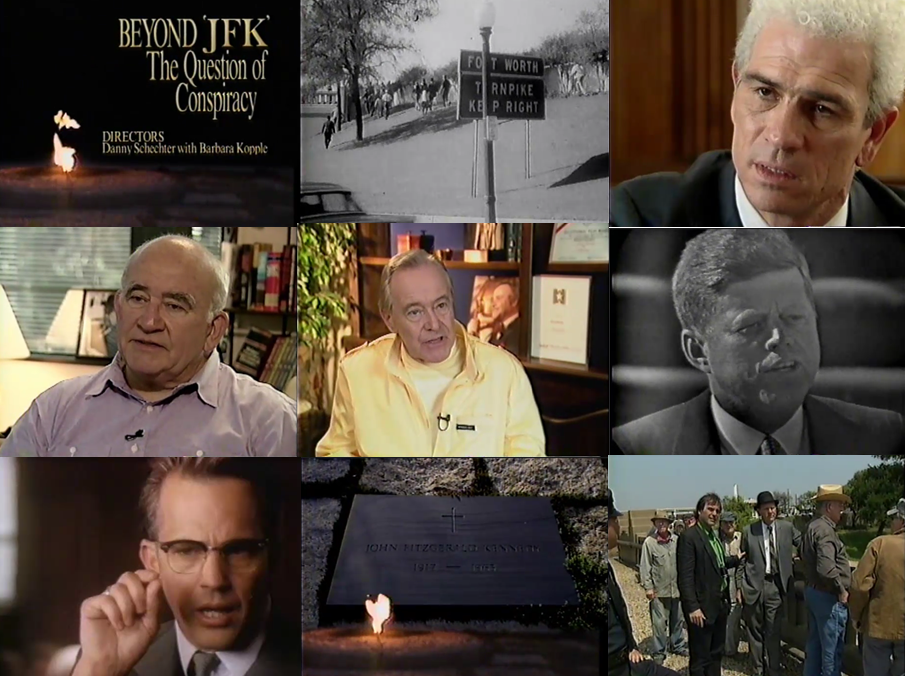
I uploaded Beyond JFK: The Question of Conspiracy at Archive.org some time ago and thought I’d share it for those who haven’t seen it yet. Click on the photo.

 
https://archive.org/details/BeyondJfkAQuestionOfConspiracy


Beyond JFK: The Question of Conspiracy is a spellbinding documentary examining the issues dramatized by the Academy Award-winning movie JFK.

Using newsreel and interview footage, this compelling piece to JFK presents many of the true-life people portrayed in the film by Kevin Costner, Tommy Lee Jones, John Candy, Kevin Bacon and others and it does more. Eyewitnesses to the tragic events of November 22, 1963 reveal astonishing testimony. Supporters of the Warren Commission’s finding provide counterpoint throughout the program. And details of the world-shattering investigations by New Orleans District Attorney Jim Garrison are set out with step-by-step clarity.

Tuesday, April 22, 2014

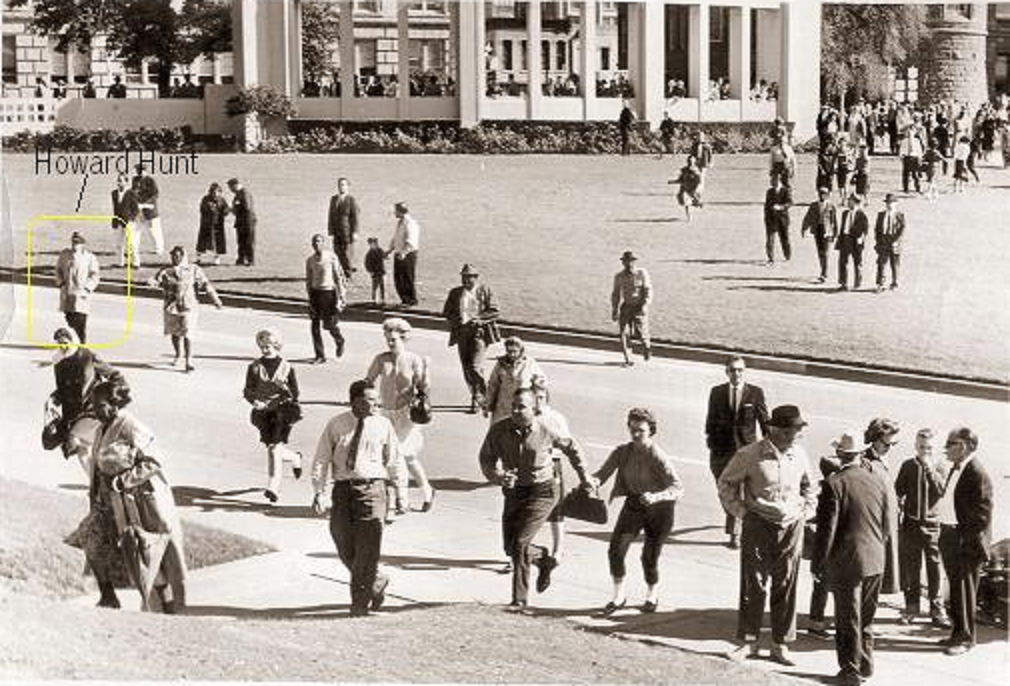
E. Howard Hunt in Dallas November 22, 1963

E. Howard Hunt was in Dallas the day of the assassination and the photo of him was verified by his son, Saint. John Hunt. When Jim Marrs showed him the photo, he responded, “That’s my dad. I recognize that trench coat. He loved it and wore it all the time.” Spooks, Lies and Dopplegangers


All Wars Are Bankers Wars


Sunday, April 20, 2014

The Intra-Administration War in Vietnam

Arthur Krock
New York Times
October 3, 1963 p. 34

WASHINGTON, Oct. 2—The Central Intelligence Agency is getting a very bad press dispatches from Vietnam to American newspapers and in articles originating in Washington. Like the Supreme Court when under fire, the CIA cannot defend itself in public retorts to criticisms of its activities as they occur. But, unlike the Supreme Court, the CIA has no open record of its activities on which the public can base a judgment of the validity of the criticisms. Also, the agency is precluded from using the indirect defensive tactic which is constantly employed by all other Government units under fire.
This tactic is to give information to the press, under a seal of confidence, that challenges or refutes the critics. But the CIA cannot father such inspired articles, because to do so would requires some disclosure of its activities. And not only does the effectiveness of the agency depend on the secrecy of its operations. Every President since the CIA was created has protected this secrecy from claimants—Congress or the public through the press, for example—of the right to share any part of it.

With High Frequency
This Presidential policy has not, however, always restrained other executive units from going confidentially to the press with attacks on CIA operations in their common field of responsibility. And usually it has been possible to deduce these operational details from the nature of the attacks. But the peak of the practice is revealed almost every day now in dispatches from reporters—in close touch with intra-Administration critics of the CIA—with excellent reputations for reliability.
One reporter in this category is Richard Starnes of the Scripps-Howard newspapers. Today, under a Saigon dateline, he related that, “according to a high United States source here, twice the CIA flatly refused to carry out instructions from Ambassador Henry Cabot Lodge … [and] in one instance frustrated a plan of action Mr. Lodge brought from Washington because the agency disagreed with it.” Among the views attributed to United States officials on the scene, including one described as a “very high American official … who has spent much of his life n the service of democracy … are the following:
The CIA’s growth was “likened to a malignancy” which the “very high official was not sure even the White House could control … any longer.” If the United States ever experiences [an attempt at a coup to overthrow the Government] it will come from the CIA, and not the Pentagon.” The agency “represents a tremendous power and total unaccountability to anyone.”

Disorderly Government
Whatever else these passages disclose, they most certainly establish that representatives of other Executive branches have expanded their war against the CIA from the inner government councils to the American people via the press. And published simultaneously are details of the agency’s operations in Vietnam that can come only from the same critical official sources. This is disorderly government. And the longer the President tolerates it—the period already is considerable—the greater will grow its potentials of hampering the real war against the Vietcong and the impression of a very indecisive Administration in Washington.
The CIA may be guilty as charged. Since it cannot, or at any rate will not, openly defend its record in Vietnam, or defend it by the same confidential press “briefings” employed by its critics, the public is not in a position to judge. Nor is this department, which sought and failed to get even the outlines of this agency’s case in rebuttal. But Mr. Kennedy will have to make a judgment if the spectacle of war within the Executive branch is to be ended and the effective functioning of the CIA preserved. And when he makes this judgment, hopefully he also will make it public, as well as the appraisal of fault on which it is based.
Doubtless recommendations as to what his judgment should be were made to him today by Secretary of Defense McNamara and General Taylor on their return from their fact-finding expedition into the embattled official jungle in Saigon.

Original NYT article


CIA Instructions to Media Assets Regarding Critics of the Warren Commission

This document caused quite a stir when it was discovered in 1977. Dated 4/1/67, and marked "DESTROY WHEN NO LONGER NEEDED", this document is a stunning testimony to how concerned the CIA was over investigations into the Kennedy assassination. Emphasis has been added to facilitate scanning.

__________


CIA Document #1035-960, marked "PSYCH" for presumably Psychological Warfare Operations, in the division "CS", the Clandestine Services, sometimes known as the "dirty tricks" department.
 
RE: Concerning Criticism of the Warren Report

1. Our Concern. From the day of President Kennedy's assassination on, there has been speculation about the responsibility for his murder. Although this was stemmed for a time by the Warren Commission report, (which appeared at the end of September 1964), various writers have now had time to scan the Commission's published report and documents for new pretexts for questioning, and there has been a new wave of books and articles criticizing the Commission's findings. In most cases the critics have speculated as to the existence of some kind of conspiracy, and often they have implied that the Commission itself was involved. Presumably as a result of the increasing challenge to the Warren Commission's report, a public opinion poll recently indicated that 46% of the American public did not think that Oswald acted alone, while more than half of those polled thought that the Commission had left some questions unresolved. Doubtless polls abroad would show similar, or possibly more adverse results.

2. This trend of opinion is a matter of concern to the U.S. government, including our organization. The members of the Warren Commission were naturally chosen for their integrity, experience and prominence. They represented both major parties, and they and their staff were deliberately drawn from all sections of the country. Just because of the standing of the Commissioners, efforts to impugn their rectitude and wisdom tend to cast doubt on the whole leadership of American society. Moreover, there seems to be an increasing tendency to hint that President Johnson himself, as the one person who might be said to have benefited, was in some way responsible for the assassination. Innuendo of such seriousness affects not only the individual concerned, but also the whole reputation of the American government. Our organization itself is directly involved: among other facts, we contributed information to the investigation. Conspiracy theories have frequently thrown suspicion on our organization, for example by falsely alleging that Lee Harvey Oswald worked for us. The aim of this dispatch is to provide material countering and discrediting the claims of the conspiracy theorists, so as to inhibit the circulation of such claims in other countries. Background information is supplied in a classified section and in a number of unclassified attachments.

3. Action. We do not recommend that discussion of the assassination question be initiated where it is not already taking place. Where discussion is active [business] addresses are requested:

a. To discuss the publicity problem with [?] and friendly elite contacts (especially politicians and editors), pointing out that the Warren Commission made as thorough an investigation as humanly possible, that the charges of the critics are without serious foundation, and that further speculative discussion only plays into the hands of the opposition. Point out also that parts of the conspiracy talk appear to be deliberately generated by Communist propagandists. Urge them to use their influence to discourage unfounded and irresponsible speculation.

b. To employ propaganda assets to [negate] and refute the attacks of the critics. Book reviews and feature articles are particularly appropriate for this purpose. The unclassified attachments to this guidance should provide useful background material for passing to assets. Our ploy should point out, as applicable, that the critics are (I) wedded to theories adopted before the evidence was in, (II) politically interested, (III) financially interested, (IV) hasty and inaccurate in their research, or (V) infatuated with their own theories. In the course of discussions of the whole phenomenon of criticism, a useful strategy may be to single out Epstein's theory for attack, using the attached Fletcher [?] article and Spectator piece for background. (Although Mark Lane's book is much less convincing that Epstein's and comes off badly where confronted by knowledgeable critics, it is also much more difficult to answer as a whole, as one becomes lost in a morass of unrelated details.) 

4. In private to media discussions not directed at any particular writer, or in attacking publications which may be yet forthcoming, the following arguments should be useful:

a. No significant new evidence has emerged which the Commission did not consider. The assassination is sometimes compared (e.g., by Joachim Joesten and Bertrand Russell) with the Dreyfus case; however, unlike that case, the attack on the Warren Commission have produced no new evidence, no new culprits have been convincingly identified, and there is no agreement among the critics. (A better parallel, though an imperfect one, might be with the Reichstag fire of 1933, which some competent historians (Fritz Tobias, AJ.P. Taylor, D.C. Watt) now believe was set by Vander Lubbe on his own initiative, without acting for either Nazis or Communists; the Nazis tried to pin the blame on the Communists, but the latter have been more successful in convincing the world that the Nazis were to blame.)

b. Critics usually overvalue particular items and ignore others. They tend to place more emphasis on the recollections of individual witnesses (which are less reliable and more divergent--and hence offer more hand-holds for criticism) and less on ballistics, autopsy, and photographic evidence. A close examination of the Commission's records will usually show that the conflicting eyewitness accounts are quoted out of context, or were discarded by the Commission for good and sufficient reason.

c. Conspiracy on the large scale often suggested would be impossible to conceal in the United States, esp. since informants could expect to receive large royalties, etc. Note that Robert Kennedy, Attorney General at the time and John F. Kennedy's brother, would be the last man to overlook or conceal any conspiracy. And as one reviewer pointed out, Congressman Gerald R. Ford would hardly have held his tongue for the sake of the Democratic administration, and Senator Russell would have had every political interest in exposing any misdeeds on the part of Chief Justice Warren. A conspirator moreover would hardly choose a location for a shooting where so much depended on conditions beyond his control: the route, the speed of the cars, the moving target, the risk that the assassin would be discovered. A group of wealthy conspirators could have arranged much more secure conditions.

d. Critics have often been enticed by a form of intellectual pride: they light on some theory and fall in love with it; they also scoff at the Commission because it did not always answer every question with a flat decision one way or the other. Actually, the make-up of the Commission and its staff was an excellent safeguard against over-commitment to any one theory, or against the illicit transformation of probabilities into certainties.

e. Oswald would not have been any sensible person's choice for a co-conspirator. He was a "loner," mixed up, of questionable reliability and an unknown quantity to any professional intelligence service. [Archivist's note: This claim is demonstrably untrue with the latest file releases. The CIA had an operational interest in Oswald less than a month before the assassination. Source: Oswald and the CIA, John Newman and newly released files from the National Archives.]

f. As to charges that the Commission's report was a rush job, it emerged three months after the deadline originally set. But to the degree that the Commission tried to speed up its reporting, this was largely due to the pressure of irresponsible speculation already appearing, in some cases coming from the same critics who, refusing to admit their errors, are now putting out new criticisms.

g. Such vague accusations as that "more than ten people have died mysteriously" can always be explained in some natural way e.g.: the individuals concerned have for the most part died of natural causes; the Commission staff questioned 418 witnesses (the FBI interviewed far more people, conduction 25,000 interviews and re interviews), and in such a large group, a certain number of deaths are to be expected. (When Penn Jones, one of the originators of the "ten mysterious deaths" line, appeared on television, it emerged that two of the deaths on his list were from heart attacks, one from cancer, one was from a head-on collision on a bridge, and one occurred when a driver drifted into a bridge abutment.)

5. Where possible, counter speculation by encouraging reference to the Commission's Report itself. Open-minded foreign readers should still be impressed by the care, thoroughness, objectivity and speed with which the Commission worked. Reviewers of other books might be encouraged to add to their account the idea that, checking back with the report itself, they found it far superior to the work of its critics.
 

Kennedy Had a Plan for Early Exit in Vietnam

December 23, 1997

Pentagon documents declassified today may rekindle the still-smoldering argument over whether President John F. Kennedy would have pulled American forces out of Vietnam.
The documents show that shortly before Kennedy was assassinated, the nation's top military leaders were going forward with his plan to withdraw American advisers from Vietnam.
''All planning will be directed towards preparing Republic of Vietnam forces for the withdrawal of all United States special assistance units and personnel by the end of calendar year 1965,'' reads an Oct. 4, 1963, memorandum drafted by Gen. Maxwell D. Taylor, Chairman of the Joint Chiefs of Staff, and discussed that day by the Chiefs.
''Execute the plan to withdraw 1,000 United States military personnel by the end of 1963,'' the memorandum continues.
No one will ever know whether these plans would have been carried out had Kennedy lived. The United States had 16,300 advisers in South Vietnam at the time. By the end of 1968, it had more than 500,000 soldiers in the country.
Historians know that Kennedy directed the Pentagon to devise the withdrawal plans. But some believe they were a political facade erected for the 1964 elections; others think they were based on overly optimistic battlefield reports; still others see them as a device to force South Vietnam's corrupt Government to change.
And Kennedy's public pronouncements on withdrawal were utterly different from his private plans. In public, he was firmly opposed to withdrawal. ''I don't agree with those who say we should withdraw,'' he told the CBS News reporter Walter Cronkite on Sept. 2, 1963. ''That would be a deep mistake.''
The documents also show that the Joint Chiefs were unhappy with the idea. Gen. Paul D. Harkins of the Army warned that it ''would have a bad effect on the Vietnamese, to be pulling out just when it appears they are winning.''
In fact, the situation in South Vietnam was deteriorating in the fall of 1963. But South Vietnam's President, Ngo Dinh Diem, was deceiving his American patrons about the progress of the war, and United States military and political leaders were deceiving themselves and one another about the conflict, many historians say.
Members of the Joint Chiefs believed that the United States should go to war against North Vietnam. But, as one newly declassified memorandum shows, the Chiefs knew that ''proposals for overt action invited a negative Presidential decision.'' Accordingly, they pressed for covert operations run by the Central Intelligence Agency, the documents show, and Secretary of Defense Robert S. McNamara promised C.I.A. officers ''whatever is necessary to accelerate their efforts.''
Presidents Diem and Kennedy were both assassinated in November 1963. Within days after taking power, the documents show, President Lyndon B. Johnson ordered ''intensified operations against North Vietnam'' both overt and covert, covering ''the full spectrum of sabotage, psychological and raiding activity.'' Mr. McNamara told the Chiefs there was ''an urgent need'' to put ''increasing pressure on North Vietnam.''
The 800 pages of Joint Chiefs records were made public today by the Assassination Records Review Board, which by law has the power to declassify secret Government records bearing on Kennedy's death.

JFK Assassination: Katzenbach Memorandum to Bill Moyers November 25, 1963

On November 25 1963, the day of the Kennedy funeral, Assistant Attorney General Nicholas Katzenbach sent a memo to Bill Moyers of the new Johnson White House. He had begun writing it the day earlier, within hours after Oswald's death at the hands of Jack Ruby.
The second paragraph stated: "The public must be satisfied that Oswald was the assassin; that he did not have confederates who are still at large; and that evidence was such that he would have been convicted at trial."
Given that the authorities could not possibly by November 25 know these things to be true, and Katzenbach later admitted he knew very little at this stage, the memo is clearly advocating a political course irrespective of the truth of the assassination.
The motivation for this political course may be glimpsed in the succeeding paragraph: "Speculation about Oswald's motivation ought to be cut off, and we should have some basis for rebutting thought that this was a Communist conspiracy or (as the Iron Curtain press is saying) a right-wing conspiracy to blame it on the Communists. Unfortunately the facts on Oswald seem about too pat--too obvious (Marxist, Cuba, Russian wife, etc.). The Dallas police have put out statements on the Communist conspiracy theory, and it was they who were in charge when he was shot and thus silenced."
Katzenbach's memo advocated a public FBI report to satisfy this "objective," though he noted the possible need for "the appointment of a Presidential Commission of unimpeachable personnel to review and examine the evidence and announce its conclusions." He ended by advocating a quick public announcement to "head off speculation or Congressional hearings of the wrong sort."
To many observers, the Katzenbach memo provides the blueprint for the cover-up which followed.


November 25, 1963
 
MEMORANDUM FOR MR. MOYERS
 
It is important that all the facts surrounding President Kennedy’s assassination be made public in a way which will satisfy people in the United States and abroad that all the facts have been told and that a statement to the effect be made now.
 
1. The public must be satisfied that Oswald was the assassin; that he did not have confederates who are still at large; and the evidence was such that he would have been convicted at trial.
2. Speculation about Oswald’s motivation ought to be cut off, and we should have more basis for rebutting thought that this was a Communist conspiracy or (as the Iron Curtain press is saying) a right-wing conspiracy to blame it on the Communists. Unfortunately the facts on Oswald seem too pat – too obvious (Marxist, Cuba, Russian wife, etc.). The Dallas police have put out statements on the Communist conspiracy theory, and it was they who were in charge when he was shot and thus silenced.
3. The matter has been handled thus far with neither dignity nor conviction. Facts have been mixed with rumor and speculations. We can scarcely let the world see us totally in the image of the Dallas police when our President is murdered.
I think the objective may be satisfied by making public as soon as possible a complete and thorough FBI report on Oswald and the assassination. This may run into the difficulty of pointing to inconsistencies between this report and statements by Dallas police officials. But the reputation of the Bureau is such that it may do the whole job.
The only other step would be the appointment of a Presidential Commission of unimpeachable personnel to review and examine the evidence and announce its conclusions. This has both advantages and disadvantages. I think it can await publication of the FBI report and public reaction to it here and abroad.
I think, however, that a statement that all the facts will be made public property in an orderly and responsible way should be made now. We need something to head off public speculation or Congressional hearings of the wrong sort.
 
Nicholas Katzenbach
Deputy Attorney General